

What should you know?
In today’s global economy, many non-U.S. nationals hold investments and RSUs in the United States. It is often seen as a financial safe haven, but a significant risk looms in the background: U.S. Estate Tax.
If you are a non-U.S. citizen residing outside of the United States (referred to by the IRS as a “Non-Resident Alien” or “NRA”), your U.S. stocks, ETFs, mutual funds, and property may be subject to a large U.S. estate tax bill upon your death.
The IRS treats NRAs very differently compared to U.S. citizens:
• U.S. citizens can transfer up to $13.6 Million tax-free to their heirs, meaning the vast majority of Americans don’t need to worry about paying estate taxes.
• NRAs, however, only receive a measly $60,000 tax-free exemption. Anything over that is liable to estate tax, which is applied progressively, rising sharply from 18% up to a maximum of 40%.
The following table shows the assets that are subject to U.S. estate tax:
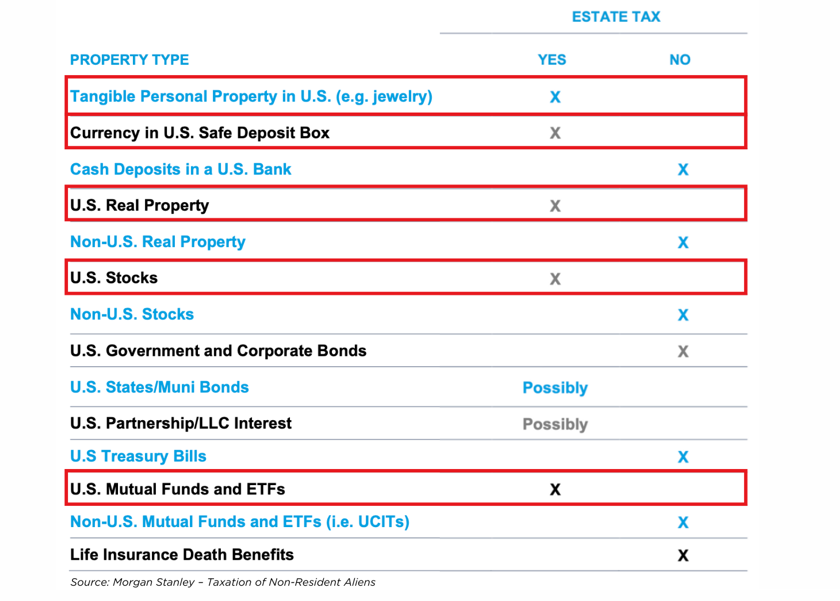
If you are an NRA and you pass away with $500,000 in U.S. situs investments or RSUs today, your estate could face a tax bill of $137,800 – that’s nearly 30% of the total value! Not only this, there will be the time consuming, and often costly probate process for your family to navigate at a time of high emotional stress.
Why should you care?
U.S. estate tax represents one of the most significant and often overlooked risks for non-residents directly holding U.S. stocks or investment funds in U.S. accounts.
This issue often arises unintentionally – either because you are unaware of the tax implications, or you hold RSUs in the U.S. because your company made the decision for you, when choosing a U.S. custodian.
The good news is, it’s a very simple problem to solve. You can hold the exact same investments in an appropriately structured account outside the United States, and eliminate U.S. estate tax exposure entirely.
The potential estate tax implications for non-U.S. citizens owning U.S. assets can be severe. However, with proper planning and guidance you can avoid or significantly reduce your U.S. estate tax liability, even while holding the same U.S. investments.