
Our brains love shortcuts. When a trend has been prevailing, we instinctively expect it to continue.
With investing, this thinking can be dangerous. Selecting investments based on recent past performance, or worse, through fear of missing out on the latest surging trend, can lead to big mistakes.
Financial markets are influenced by a multitude of factors – economic conditions, political events, technological shifts, investor sentiment, even natural disasters. These factors interact in unpredictable ways, creating a constantly changing environment. A company, or sector that thrived under certain conditions can reverse sharply when circumstances shift.
During the dot-com bubble of the late 1990s, technology stocks soared as investors rushed to invest in internet-related companies. When the bubble burst in 2000, those same stocks crashed sharply. Investors who had assumed that past rapid growth would continue unabated experienced big losses.
The 2008 global financial crisis told a similar story. Shares of banks, many of which had consistently delivered reliable returns up to that point, suddenly plummeted. Many never recovered.
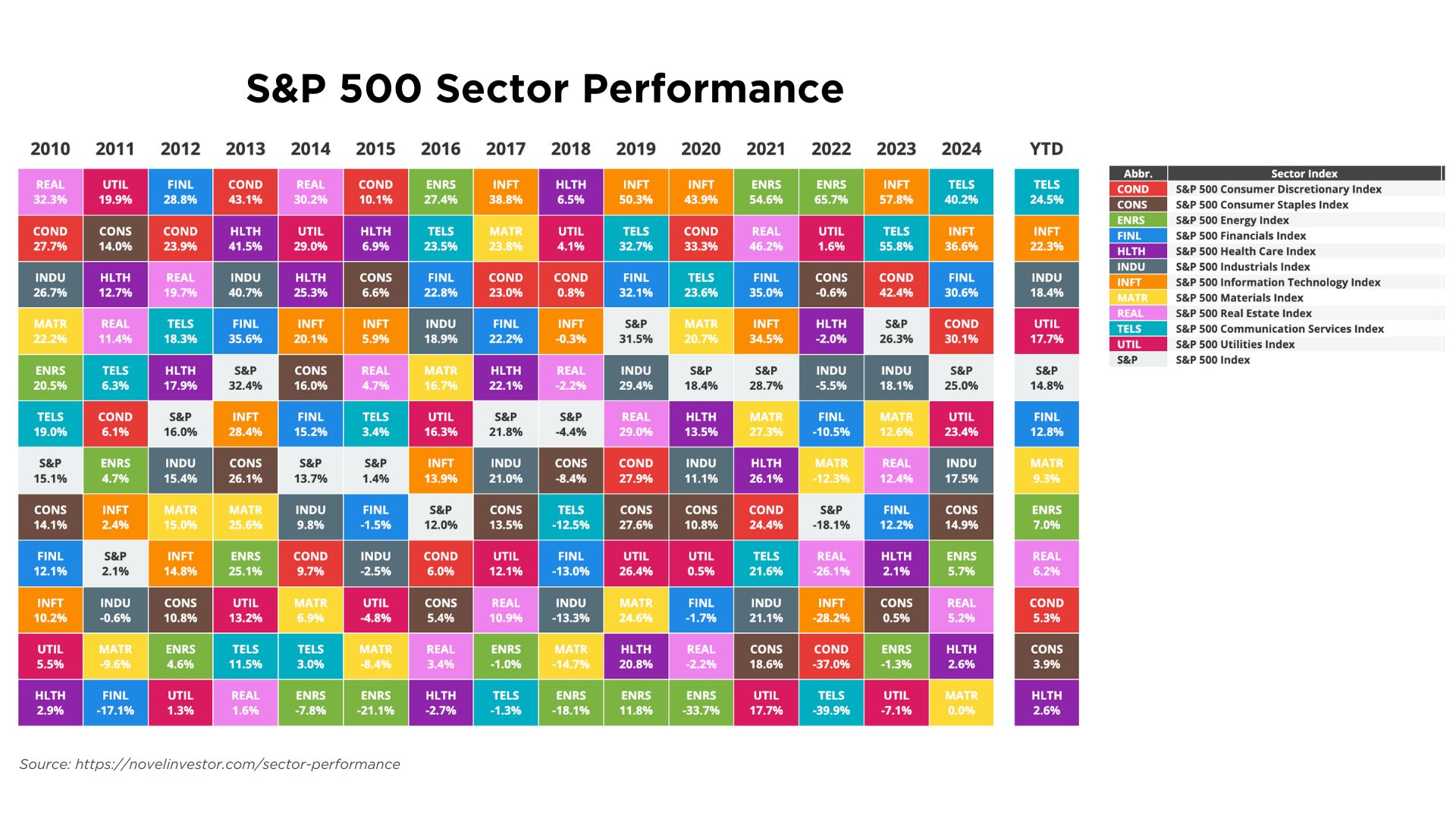
The chart below shows the annual performance of each industry sector in the S&P 500 over the past 15 years. Notice how many sectors have spent time at both the top and bottom of the rankings, sometimes in very close succession:
Why should you care?
Diversification isn’t exciting, but it’s something of a “free lunch” in investing.
A properly diversified portfolio – one that holds a bit of everything across geographies and sectors – means you participate in the long-term growth of the world economy without the risks of getting it dangerously wrong.
You won’t capture the full upside of any single winner, but crucially, you won’t suffer the full downside if things don’t go to plan.
A strategy rooted in diversification is far more likely to withstand the test of time than chasing whatever’s trending right now. When prices get pushed up sharply by excitement and hope, there’s often a painful reset waiting around the corner.
Your job isn’t to predict which stock or sector will win next year – nobody can do that consistently. Your job is to stay invested, stay diversified, and keep looking through the windscreen, not the rear-view mirror.