
What should you know?
There are broadly two approaches to investing:
Follow the market: using passive investment funds to track a specific index (like the S&P 500). No active decision-making takes place, the portfolio simply mirrors the composition and returns of the market it follows. Fees tend to be very low, due to the simple structure.
Try to ‘beat the market’: selecting specific investments, with the goal of outperforming the market. While some individual investors make these choices themselves, most invest via active funds, relying on professional fund managers to handle the selection. These tend to charge higher fees due to their greater complexity and operating costs.
The idea of ‘Beating the market’ has long been the premise of many investment managers. But how many actually succeed?
The pie charts below illustrate the percentage of active US equity funds that underperformed their respective benchmarks over a 20-year period ending December 2023:
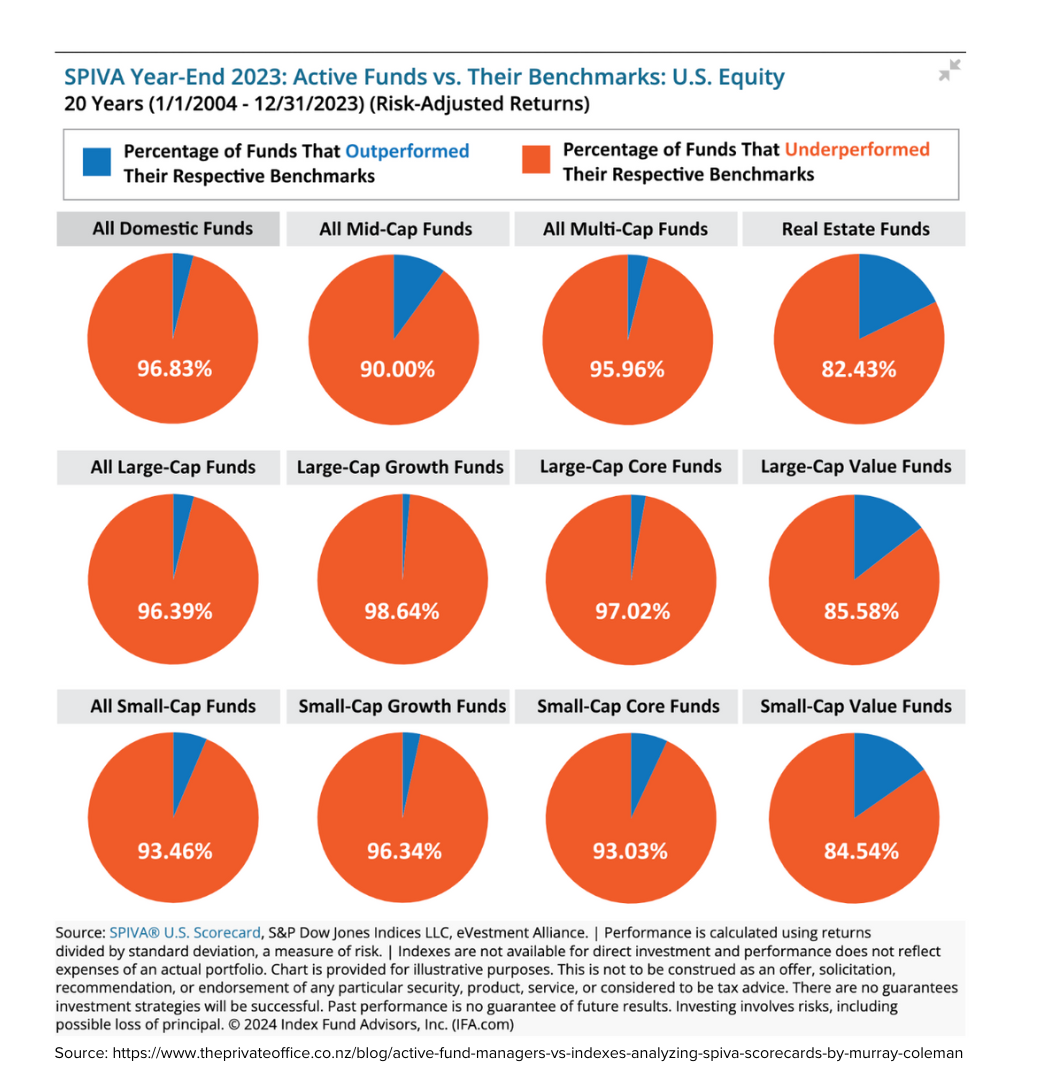
While both active and passive approaches can claim to have delivered meaningful long-term growth for disciplined investors, the evidence from the past 20 years shows that fewer than 1 in 10 active funds were able to consistently outperform their benchmarks over that timeframe.
Why should you care?
Investing is unique in that the benefits often come from what you DON’T pay for, rather than what you DO.
Predicting the future is almost impossible, and when you add the higher costs active fund managers levy, it’s clear why they often struggle to match the market over the long term.
While there are exceptions, the evidence is compelling: when faced with the choice between a 100% chance of achieving full market returns and a 90% chance of falling short, the passive approach is the more reliable way to grow your wealth.