

Over the past 15 years, U.S. equities have dominated global markets, outperforming other regions in 10 of those 15 years and rewarding investors who were heavily weighted towards American stocks.
But as the chart below illustrates, this has not always been the case. Regional equity returns have tended to move in cycles, with no region holding the crown forever:
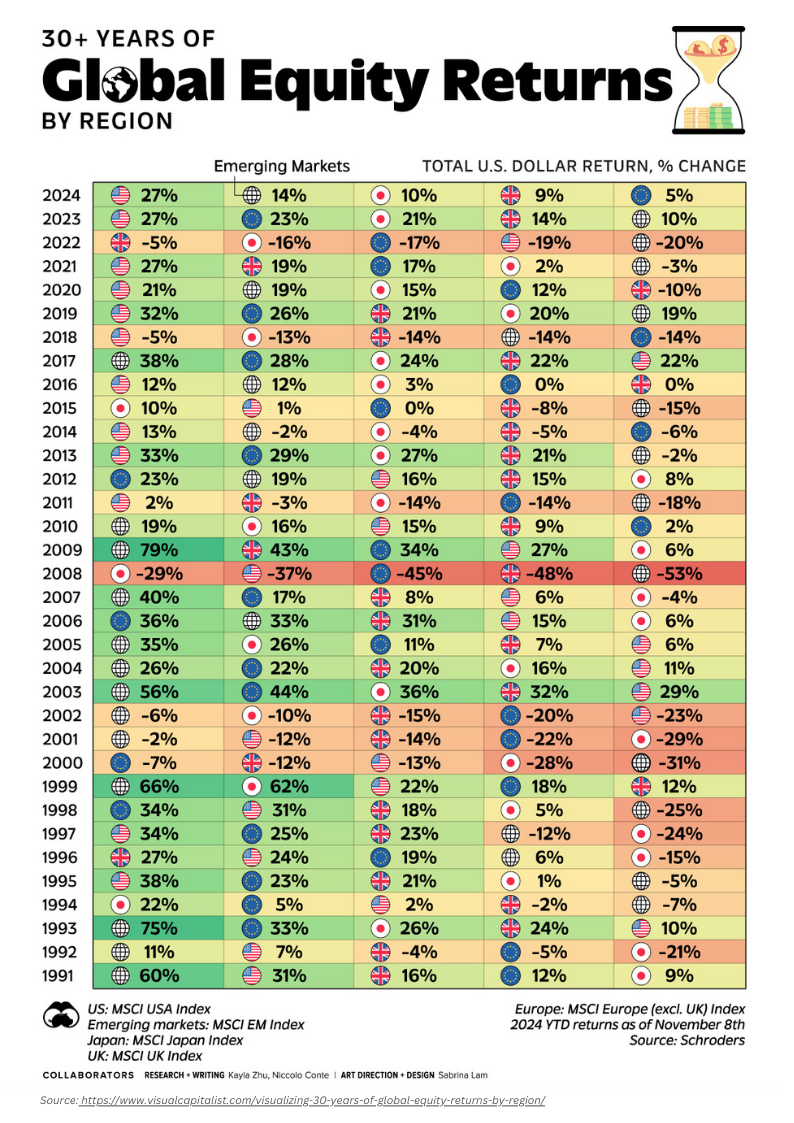
It’s easy to forget that in the 1980s, Japan was dominant, rising nearly tenfold between 1980 and 1989, before suffering a painful correction in the 1990s.
From 1991 to 2010, emerging markets – driven by countries like China, India, and Brazil – led global returns in 12 out of 20 years. During 2001–2010 alone, the MSCI Emerging Markets Index delivered an impressive 15.9% annualised return.
Since 2011, however, that momentum has faded. While U.S. equities surged ahead, emerging markets returned just 0.9% annually.
Trends shift, and often without warning.
Why should you care?
No single region can be relied upon to remain on top forever. Countries and markets move in cycles, influenced by local economic conditions, monetary policy, demographics, innovation, and geopolitical events.
Concentrating your investments in a single region – even one with a stellar past – can leave you exposed if momentum shifts.
A globally diversified portfolio reduces dependence on any one market and spreads exposure across regions. This helps to smooth returns across economic cycles and ensures your investments are prepared for a range of scenarios.