
Happiness tends to follow a U-shaped curve through life.
This was the outcome of a global study by David G. Blanchflower and Andrew J. Oswald, who investigated how happiness and life satisfaction evolve with age.
People in their younger years reported high levels of wellbeing, which then declined steadily into middle age, with those in their 40s being the least happy.
Then something surprising happened. Rather than continuing on a downward path across the course of life, happiness began to rise again around age 50, increasing steadily to those in their 80s.
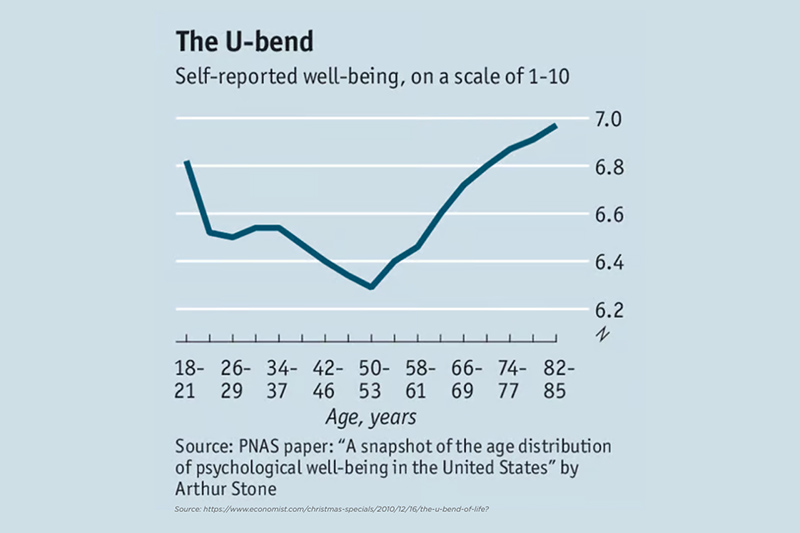
Despite the physical and health-related challenges that often accompany ageing, people in later life, on average, reported greater life satisfaction than those half their age.
So why is this?
Many aspects of life—such as relationships, education, income and health—shape the way you feel.
Maturity and life experience often bring a new perspective and priorities become clearer.
As you age, your focus tends to move away from professional ambition and external achievements, and towards family, purpose, and personal fulfilment. You begin to recognise what truly matters, and learn to let go of what doesn’t.
So as you look ahead, do so with excitement and positivity. The second half of life is full of opportunity, and with a little intention, you can create a plan that helps you to make the very most of those years.